
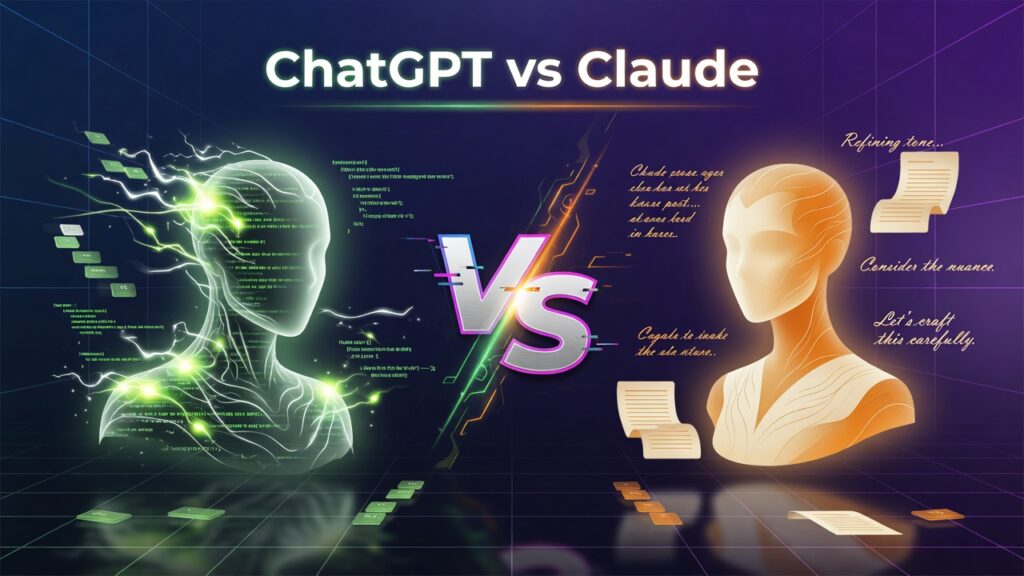
Let’s cut through the hype for a second.
Everybody and their grandma has an opinion on AI writing tools now. One guy says ChatGPT is the king. Another swears Claude writes like a thoughtful English major who drinks black coffee and judges your punctuation. Meanwhile, half the internet is out here acting like choosing an AI tool is some kind of spiritual journey.
It’s not.
If you care about writing, the real question is simple:
Which one helps you write better, faster, and with less nonsense?
That’s where this showdown comes in.
I’ve spent time with both, and here’s the truth: ChatGPT and Claude are both very good, but they shine in different ways. One feels more versatile and energetic. The other often feels calmer, cleaner, and more naturally “writerly.”
So if you’re trying to figure out which one is better for blog posts, emails, scripts, outlines, rewrites, and all the other stuff people pretend they’re not using AI for… here’s the real breakdown.
The Quick Answer
If I had to oversimplify it like a menace:
- ChatGPT is the more flexible all-rounder.
- Claude often feels better for cleaner long-form writing and more natural-sounding drafts.
That’s the short version.
But of course, life is annoying, so the real answer depends on what kind of writing you do.
ChatGPT for Writing: Fast, Flexible, and Good at Almost Everything
ChatGPT is kind of like that person who can walk into any room and be at least a little useful.
Need a blog post? It can do that.
Need email copy? Easy.
Need a YouTube script, product description, landing page outline, social caption, or a rewrite that sounds less like a corporate hostage letter? It can handle all of it.
What makes ChatGPT strong for writing is how adaptable it is.
You can push it to be:
- professional
- conversational
- punchy
- persuasive
- structured
- weird in a good way
- weird in a bad way if your prompt is trash
That last part matters.
ChatGPT tends to respond well when you give it a clear voice or role. If you tell it to sound witty, sharp, direct, and human, it usually gets pretty close. And if it misses, it’s often easier to keep steering it until it lands where you want.
That’s a huge plus if you write a lot of different kinds of content.
Where ChatGPT wins
- Better versatility across different writing tasks
- Great for brainstorming and idea generation
- Strong at quick drafts and fast rewrites
- Usually better when you want structure, variety, or experimentation
- Feels more like a creative assistant that can pivot fast
Where ChatGPT can annoy you
Sometimes it gets a little too polished.
Sometimes it sounds just a bit too eager.
And every now and then it writes like it’s trying very hard to win “Employee of the Month” at the Content Factory.
In other words, it can drift into that classic AI tone if you don’t guide it well.
Not terrible. Just… a little fake-nice sometimes.
Claude for Writing: Smoother, Cleaner, More Naturally Human
Claude feels different.
Where ChatGPT often comes in energetic and adaptable, Claude tends to feel more restrained, more thoughtful, and honestly a little more natural out of the gate for certain writing tasks.
If ChatGPT is the smart multitool, Claude is the person quietly handing you a cleaner draft without needing applause.
For writing specifically, Claude often does really well with:
- long-form blog content
- essays
- thoughtful rewrites
- tone cleanup
- making rough writing sound more human
- keeping a steadier voice across bigger chunks of text
A lot of people like Claude because it often feels less “salesy” and less “look at me, I’m helping” than other AI tools.
That can be a big advantage.
If you hate overly shiny, overly enthusiastic, overly AI-sounding copy, Claude can feel refreshingly calm. It often gives you prose that needs fewer eye-rolls and less cleanup.
Where Claude wins
- Often sounds more natural in long-form writing
- Strong at maintaining tone
- Good at thoughtful rewrites and refinement
- Usually less robotic-sounding on the first try
- Great when you want cleaner prose instead of 19 hyperactive options
Where Claude can annoy you
Claude can sometimes feel a little too soft.
It may play it safer.
It may not give you as much range or punch right away.
And if you want something more aggressive, more ad-driven, or more creatively wild, you may have to nudge it harder.
Basically, Claude can write nicely, but sometimes you want a little more fire and a little less “respectfully, here is a balanced paragraph.”
Which One Is Better for Blog Writing?
This is close.
If you write blog content and want:
- strong outlines
- quick topic angles
- headline variations
- SEO-friendly structure
- flexible voice control
ChatGPT has the edge.
It’s usually better when you want speed and range.
But if you already have a rough draft and want it to sound:
- smoother
- more natural
- less robotic
- more readable
Claude is excellent for cleanup and refinement.
So for blog writing, my honest answer is:
- ChatGPT is better for building
- Claude is better for softening and refining
That’s why a lot of people end up liking both, even if they pretend they’re loyal to one like it’s a football team.

Which One Is Better for Emails and Sales Copy?
For emails, especially business emails, follow-ups, outreach, and persuasive messaging, I’d lean ChatGPT.
Why?
Because ChatGPT tends to be better when you want:
- multiple versions fast
- different tones
- stronger calls to action
- sharper positioning
- more variation in phrasing
It’s better at giving you options you can work with quickly.
Claude can still do good email writing, but ChatGPT usually feels more useful when you’re trying to get to a punchier final version faster.
So if your work involves:
- sales emails
- outreach
- follow-ups
- direct response style writing
- landing page style messaging
ChatGPT is probably the better fit.
Which One Is Better for Sounding Human?
This is where Claude gets a lot of love.
Out of the box, Claude often sounds a little more natural and less obviously AI-generated, especially in long paragraphs. It tends to avoid some of that “helpful assistant with suspiciously perfect manners” energy.
That said, ChatGPT can absolutely sound human too. You just usually need to guide it more clearly.
So if your prompts are weak, Claude may give you the better first draft.
If your prompts are strong, ChatGPT can absolutely compete.
That’s the real difference a lot of people miss.
Sometimes people say Claude is “better,” when what they really mean is:
Claude is better without much effort.
That’s not the same thing.
Which One Is Better for Creative Writing?
This one depends on what kind of creative writing you mean.
If you want:
- more experimentation
- more energy
- more ideas
- faster brainstorming
- more playful direction changes
ChatGPT is more fun.
If you want:
- smoother prose
- more consistent tone
- cleaner emotional rhythm
- less cheesy output on the first pass
Claude can feel better.
So for creative work, I’d say:
- ChatGPT is the better creative partner
- Claude is the cleaner stylist
One is more likely to throw ten ideas at the wall.
The other is more likely to quietly hand you something decent with fewer embarrassing sentences.
Both have value.
My Honest Verdict
If I could only choose one for writing overall, I’d give the edge to ChatGPT for most people.
Why?
Because writing online is not just about writing beautifully.
It’s about:
- speed
- flexibility
- rewriting
- headlines
- hooks
- structure
- adapting to different formats
- and getting unstuck fast
ChatGPT is just more useful across more writing situations.
But if your main goal is:
“I want this to sound smoother, more natural, and less AI-ish without fighting the tool too much,”
then Claude is incredibly good.
So here’s the simplest verdict I can give:
Choose ChatGPT if:
- you write a lot of different kinds of content
- you want flexibility
- you need ideas, outlines, rewrites, and variations fast
- you like steering the tool until it sounds right
Choose Claude if:
- you care most about clean natural prose
- you do more long-form writing
- you want softer, smoother first drafts
- you hate overly polished AI-sounding copy
Final Thoughts
This is one of those comparisons where people want a dramatic winner, but the truth is more useful than that.
ChatGPT is the stronger all-around writing tool.
Claude is often the more naturally elegant writer.
So the “best” one really comes down to how you work.
If you want a flexible writing machine that can do a little bit of everything, go with ChatGPT.
If you want an AI that often sounds more human right out of the gate, Claude deserves real respect.
Either way, the real secret is still the same:
A good prompt beats blind loyalty.
Because yes, the tool matters.
But half the time the real issue is the person typing “write me a good article” and then acting shocked when the result sounds like oatmeal.