
Let’s be real: AI comparison articles are usually one of two things.
Either they read like a lab report written by someone who has never touched grass, or they act like every AI tool is “amazing” and “game-changing” because they’re terrified of hurting somebody’s affiliate commission.
So let’s cut through the fluff.
In this guide, I’m comparing ChatGPT, Claude, Gemini, and Grok based on what actually matters in 2026: writing, research, coding help, speed, usefulness, day-to-day feel, and whether the tool is actually worth opening again tomorrow.
Because that’s the real test, right?
Not who has the fanciest marketing page.
Not who says “multimodal” the most.
Not who made the prettiest keynote.
Just this: which one is actually the best to use?
Quick Answer
If you want the quick, no-BS version:
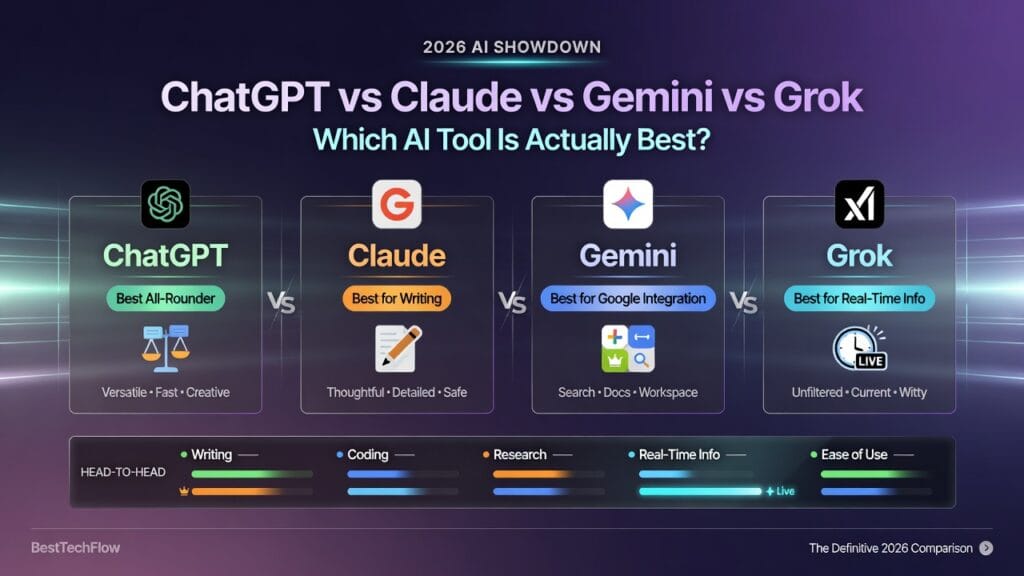
- Best overall: ChatGPT
- Best for long-form writing: Claude
- Best for Google-heavy users: Gemini
- Best for real-time, internet-aware use: Grok
That’s the short answer.
The longer answer is that all four are good at something, but they do not feel the same once you actually start using them for real work. One feels like the all-around starter pick. One feels like the thoughtful writer. One feels like it was raised inside Google Docs. And one feels like it drank three energy drinks and read the internet before breakfast.
And honestly? That’s what makes this comparison worth doing.
ChatGPT vs Claude vs Gemini vs Grok: Quick Comparison
| Tool | Best For | Biggest Strength | Main Weakness | My Take |
|---|---|---|---|---|
| ChatGPT | All-around use | Most balanced overall | Sometimes feels broad instead of specialized | Best for most people |
| Claude | Writing and reading | Smooth, natural long-form output | Can feel less punchy for fast workflows | Best for writers |
| Gemini | Google ecosystem use | Strong fit with Google tools | Can feel less consistent depending on the task | Best for Workspace users |
| Grok | Real-time and trend-aware use | Fast, current-feeling, more plugged into the internet | Less polished for structured work sometimes | Best for social and fast-response users |
Which AI Tool Is Best Overall?
If I had to recommend one AI tool to most people without turning it into a whole therapy session, I’d say ChatGPT.
Why?
Because it does the widest range of tasks well.
It can help with writing, brainstorming, coding, planning, summarizing, explaining, idea generation, and work-related tasks without feeling overly narrow. It’s the one that most consistently feels like a true all-around assistant instead of a tool that’s amazing in one lane and weird everywhere else.
That does not mean it wins every category.
Claude often feels better for calm, thoughtful, polished writing. Gemini makes more sense if your whole life runs through Gmail, Docs, Drive, and the rest of Google’s kingdom. Grok can feel faster and more connected to what’s happening right now, especially if you like a more internet-native tone.
But if you want the safest pick for the average user, ChatGPT is still the easiest recommendation.
It’s the “if I could only keep one” option.
Which is annoying, because I wish this article had a more dramatic ending, but truth is truth.
Best AI for Writing
This one goes to Claude.
Claude has a smoother writing voice than most AI tools. It tends to feel less stiff, less overcooked, and less like it’s trying to win a student-of-the-month award with every paragraph. When you need long-form writing, article drafts, thoughtful rewrites, summaries, or content that sounds more natural out of the gate, Claude is hard to ignore.
That’s especially true if you care about flow.
Some AI tools give you technically correct writing that still somehow feels like it was assembled in a conference room. Claude is better at sounding composed, readable, and human-ish without constantly needing you to say, “Okay, now make it less robotic.”
If your main priority is writing quality, Claude deserves real respect.
Best AI for Research and General Problem-Solving
This is where ChatGPT pulls ahead again.
For general research support, idea organization, brainstorming, outlining, comparing options, explaining concepts, and helping you think through a problem, ChatGPT feels the most flexible.
It’s not just about getting an answer. It’s about helping you work through messy thoughts without making you feel like you need to speak in perfect prompts just to get something useful back.
That matters more than people admit.
A lot of people do not need an AI tool that wins a benchmark war. They need something that helps them take a half-baked idea, clean it up, pressure test it, and turn it into something usable.
That’s where ChatGPT shines.
It feels more like a real working companion and less like a demo trying to impress you for fifteen seconds.
Best AI for Coding Help
For most regular people, I’d still give this to ChatGPT.
It’s usually the most practical when you need help debugging, understanding code, restructuring something, or getting walked through a problem step by step. It’s especially strong if you’re not just looking for code, but also for clear explanation.
That’s the difference between a tool that helps and a tool that just flexes.
Because let’s be honest: a lot of coding help on the internet boils down to somebody pasting a mysterious fix and basically saying, “Good luck, champ.” ChatGPT is better at actually walking through what’s wrong and why.
Claude is strong here too. Grok is clearly pushing hard in reasoning and coding. Gemini can absolutely be useful. But if I’m recommending one tool to somebody who wants the best balance of code help plus clarity, I’m still leaning ChatGPT.
Best AI for Google Users
If you live inside Google’s ecosystem, Gemini makes the most sense.
And I mean really live in it.
If your day is Gmail, Docs, Drive, Sheets, Meet, and everything else with a Google logo slapped on it, Gemini has a real advantage because it fits naturally into that world. It feels less like adding another tool and more like extending the tools you already use.
That convenience matters.
A lot of people do not want to jump between six apps and pretend that’s productivity. They want the shortest path between “I need help with this” and “cool, it’s done.”
That’s Gemini’s lane.
The catch is that for pure output quality, it doesn’t always feel as consistently sharp as ChatGPT or as naturally polished as Claude. But if your workflow is already heavily Google-based, Gemini becomes a much more serious contender than people give it credit for.
Best AI for Real-Time Feel and Internet Awareness
This is where Grok stands out.
Grok feels more tuned into the modern internet than the others. It has more of that fast, current, plugged-in energy. It doesn’t feel as buttoned-up. It feels more like it knows what people are actually talking about right now.
That can be a huge plus depending on what you want.
If you care about trends, fast reactions, current conversations, or a less polished, more internet-native vibe, Grok has a different flavor than the others. It’s less “corporate assistant in a sweater vest” and more “smart friend who is online way too much but somehow still useful.”
Now, that same energy can be a downside too.
Because when you need structure, polished writing, or careful long-form work, Grok can feel less locked in than ChatGPT or Claude. But for speed, real-time feel, and internet-aware interaction, it absolutely has its own lane.
And to be fair, that lane is more useful than a lot of people expected.
Pros and Cons of Each Tool
ChatGPT
Pros
- Best all-around balance
- Great for writing, brainstorming, coding, and workflow help
- Easy to use for both beginners and power users
- Feels the most versatile day to day
Cons
- Doesn’t always feel like the absolute best specialist in every single category
- Can sometimes give broad answers if your prompt is too vague
- If you want one very specific style, you may still need to steer it
Claude
Pros
- Excellent long-form writing
- Strong summaries and thoughtful output
- Calm, readable tone
- Great for content-heavy work
Cons
- Can feel less dynamic for fast-moving tasks
- Not always my first pick for general workflow power
- More “thoughtful writer” than “Swiss Army knife”
Gemini
Pros
- Strong fit for Google users
- Useful inside a Google-centered workflow
- Good if you want AI closer to your everyday tools
- Can make sense for people already paying for Google services
Cons
- Output can feel less consistent depending on the task
- Less memorable as a standalone experience
- Harder to recommend as the best overall unless you’re already deep in Google land
Grok
Pros
- Fast, current-feeling, internet-aware
- Strong personality
- Good for trend-aware and real-time-style use
- Feels different from the more polished competitors
Cons
- Not always the most structured for serious writing
- Less dependable for polished long-form work
- Can feel a little looser than some users want
So Which One Should You Actually Use?
Here’s my honest take.
If you want the best overall AI tool, go with ChatGPT.
If your main thing is writing, especially longer and more natural writing, go with Claude.
If you already live in Google Workspace, Gemini makes the most sense.
If you want something that feels more real-time, internet-aware, and plugged into what’s happening now, Grok is the one that stands out.
That’s really what this comes down to: not “which AI is best in theory,” but which AI is best for the way you actually work.
Because the truth is, most people are not choosing between four perfect tools.
They’re choosing between:
- the one they’ll actually use,
- the one that fits their workflow,
- and the one that doesn’t make them want to close the tab after five minutes.
That’s why ChatGPT still wins for most people.
It’s the most complete package.
Not because the others are bad.
Not because the race is over.
Just because right now, it’s still the tool that gives the fewest reasons to leave.
Final Verdict
If I had to rank them today, here’s how I’d put it:
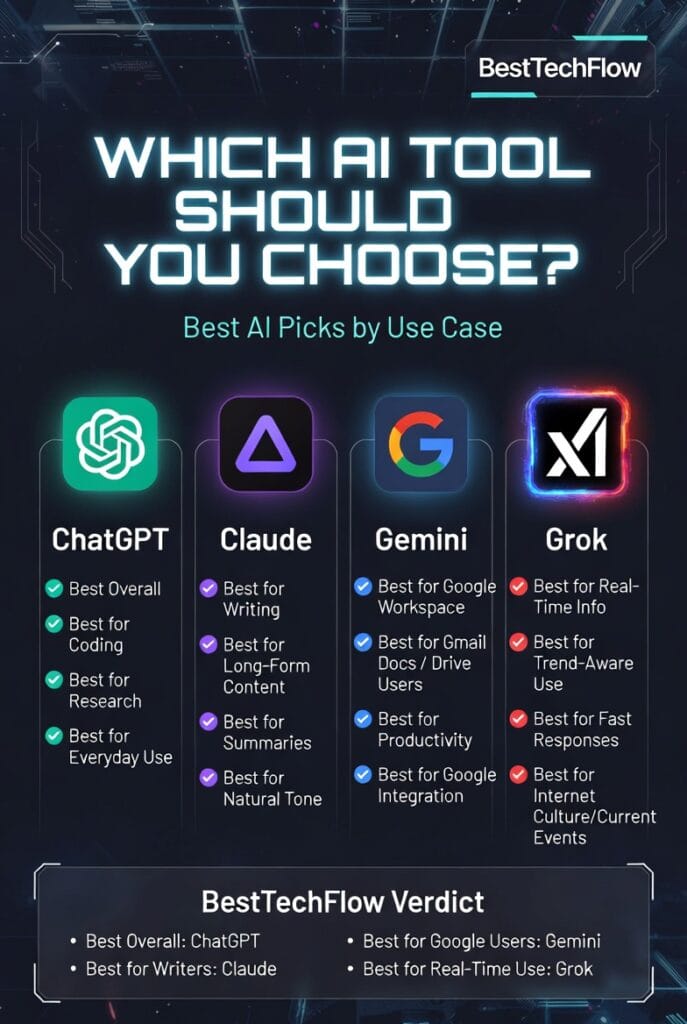
- ChatGPT — best overall for most users
- Claude — best for writing and thoughtful long-form output
- Gemini — best for Google ecosystem users
- Grok — best for fast, trend-aware, real-time-style interaction
That ranking could change depending on what you care about most.
But for the average person trying to get real value from AI in 2026 without drowning in hype, this is the order I’d start with.
And honestly, that’s the whole point of this article.
Not to crown a fake universal winner.
Just to help you waste less time.
A beautiful mission, really.
FAQ
Is ChatGPT better than Claude?
For most people, yes. ChatGPT is the better all-around tool. Claude is still excellent, especially for writing, but ChatGPT is more versatile across more tasks.
Is Gemini worth it in 2026?
Yes, especially if you already use Gmail, Google Docs, Drive, and other Google tools all day. That’s where Gemini makes the most sense.
Is Grok actually good?
Yes, especially if you want something faster, more internet-aware, and less stiff. It’s not my top pick for every task, but it absolutely has a place.
Which AI tool is best for writing?
Claude is usually the best choice for writing quality, especially longer-form and more polished writing.
Which AI tool is best overall?
Right now, ChatGPT is still the best overall pick for most people.